Top 12 Codeless Automation Testing Tools for QA Teams in 2026
Discover the 12 best codeless automation testing tools for web, API, and mobile. Our 2026 guide helps you choose the right platform for your QA workflow.
Discover how artificial intelligence in automation testing is revolutionizing QA. Learn practical strategies, key benefits, and how to implement AI today.
Automate and scale manual testing with AI ->
Artificial intelligence is bringing a much-needed layer of intelligence to automation testing, making our tests faster, smarter, and more adaptable. It’s a shift away from the old, rigid scripts. Instead, we’re now using machine learning and other AI techniques to analyze, predict, and fine-tune the entire testing process. This approach is absolutely essential for keeping up with the complexity and breakneck speed of modern software development.
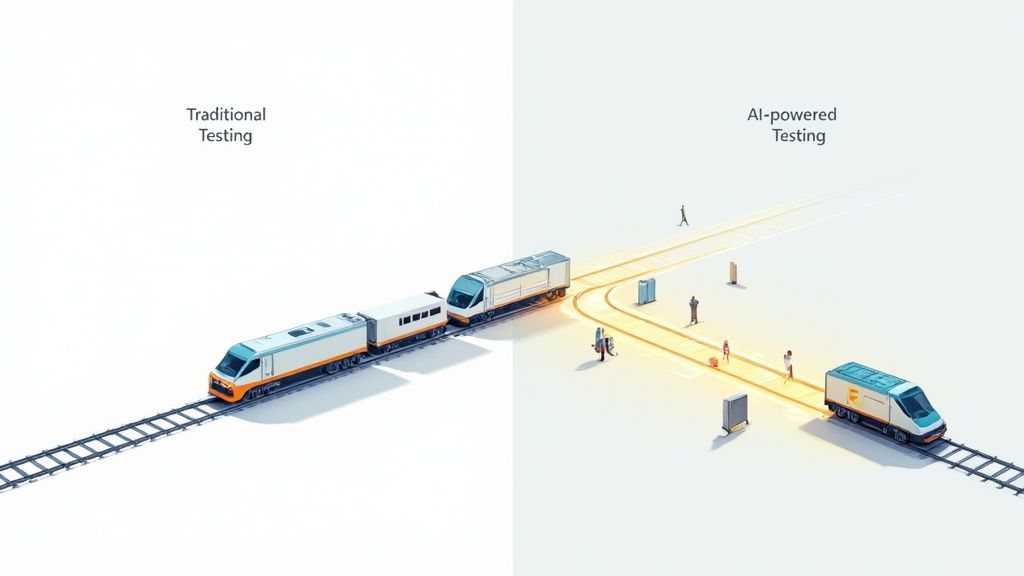
The world of software testing is in the middle of a massive change, leaving behind the stiff, manual processes for dynamic, AI-backed automation. For years, traditional automation was the reliable workhorse of QA, methodically running predefined scripts to check if an application worked as expected.
Think of traditional automation like a train running on a fixed track. It’s powerful and gets the job done, but only as long as that track stays exactly the same. The moment a small detail changes—a UI element’s ID gets updated, a button moves—the whole thing derails. This brittleness is the fundamental weakness of conventional testing.
Traditional test scripts are notoriously fragile. A tiny tweak to an application’s code can easily break dozens of tests, trapping QA teams in a never-ending cycle of script maintenance. This constant firefighting eats up time and money, slowing down releases when everyone is trying to move faster. The problem is even worse in Agile and DevOps shops where the application changes almost daily.
This is where artificial intelligence in automation testing steps in. Instead of a train on a fixed track, AI-driven testing is more like an all-terrain vehicle with a smart GPS. It knows the destination (the testing goal) and can cleverly navigate around any unexpected roadblocks to get there.
AI brings genuine adaptability to the testing lifecycle. By using machine learning and visual recognition, AI-powered tools can actually understand the application’s context, identify elements by sight, and adjust to UI changes on the fly—all without a person stepping in. This isn’t just a small improvement; it’s a completely new way to approach quality.
Here are the key problems AI helps solve:
Let’s take a look at how these two approaches stack up side-by-side.
The table below gives a quick comparison, highlighting the key differences between conventional script-based automation and the more intelligent, AI-powered testing methods we’re seeing today.
| Aspect | Traditional Automation | AI-Driven Automation |
|---|---|---|
| Test Creation | Manual script writing based on test cases. | Automated test generation from user stories or models. |
| Maintenance | High; scripts break easily with UI changes. | Low; self-healing tests adapt to changes automatically. |
| Resilience | Brittle; highly dependent on specific locators. | Robust; uses visual and contextual locators. |
| Test Coverage | Limited to predefined scenarios. | Expands coverage by discovering new user paths. |
| Human Effort | High; requires constant script management. | Low; frees up QA teams for strategic tasks. |
| Execution | Follows a rigid, linear path. | Dynamic and adaptive; can navigate unexpected flows. |
This comparison makes it clear: we’re moving from a reactive, maintenance-heavy model to a proactive, intelligent one.
This evolution is happening for a reason. The global automation testing market is on track to hit around $68 billion by 2025, and a huge part of that growth is fueled by AI. It shows the industry gets it—intelligent automation is a must-have, with 44% of IT companies already using it to cover at least half of their testing.
This transition marks a move from simple script execution to intelligent test orchestration. The goal is no longer just to find bugs but to prevent them by embedding intelligence directly into the development pipeline.
Ultimately, this shift is critical for any organization that wants to ship high-quality software quickly. Understanding how artificial intelligence is transforming testing practices from the ground up is the first step toward building more resilient and efficient QA processes that align with modern business needs.
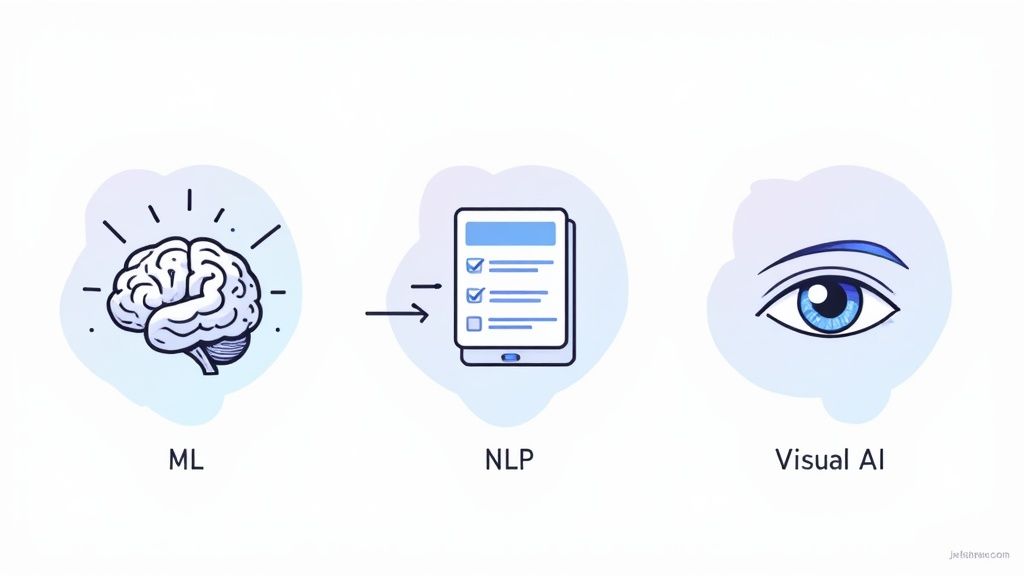
To really get what artificial intelligence in automation testing is all about, you have to pop the hood and see what’s actually running the show. We’re not talking about abstract ideas here. We’re talking about specific, powerful technologies that solve the real-world headaches QA teams face every single day.
Each piece of the AI puzzle plays a distinct role, transforming brittle, rigid test scripts into smart, adaptable agents. Let’s break down the main components that are reshaping how we think about software quality, moving it from a reactive chore to a proactive, data-informed strategy.
At the very core of AI-driven testing, you’ll find Machine Learning (ML). The best way to think of it is as the predictive brain of your entire testing operation. ML algorithms are built to churn through huge datasets, spot hidden patterns, and then make educated guesses about what’s coming next—all without someone having to hard-code every possible rule.
In a testing context, ML models analyze everything from historical test runs and bug reports to recent code commits. It’s a lot like how a credit card company’s fraud system learns from millions of transactions to flag a purchase that just doesn’t feel right. In the same way, ML learns what a “healthy” test run looks like, allowing it to pinpoint anomalies that could signal a new defect.
By learning from past failures and successes, Machine Learning models can predict high-risk areas in an application, helping teams focus their limited testing resources where they will have the most impact.
This predictive power is a complete game-changer. Instead of giving every part of an application the same amount of attention, teams can use ML insights to zero in on features that are statistically more likely to break after a new piece of code is pushed.
Next up is Natural Language Processing (NLP), the technology that acts as a bridge between plain human language and computer code. Simply put, NLP gives machines the ability to read, understand, and act on text in a way that feels surprisingly human. For test creation, this is huge.
Historically, writing any kind of automated test meant you needed to know how to code. NLP smashes that barrier. Now, any team member—from product managers to business analysts—can write out test cases in plain English, and the AI handles the heavy lifting of translating those instructions into executable scripts. If you want to dive deeper into how AI orchestrates these kinds of tasks, you can find a fantastic ultimate AI automation guide on agentic workflows.
For instance, someone could just write:
The NLP model gets the intent behind these sentences and generates the necessary automation code. This doesn’t just make test creation faster; it opens up the whole process, making it more collaborative and accessible to people who aren’t developers.
Finally, there’s Visual AI (often called computer vision), which gives automation tools a pair of eyes to “see” a user interface the same way a person does. Traditional automation is completely dependent on code-based locators like CSS IDs or XPath to find elements on a page. The moment a developer changes those locators, the tests break. It’s a constant, frustrating cycle.
Visual AI sidesteps this problem entirely. Instead of digging through code, it captures a visual snapshot of the UI and identifies elements based on how they look. It can recognize a button, a form, or an image, even if its underlying code has been completely rewritten.
This makes it incredibly good at catching the kinds of visual bugs that code-based tests are blind to, such as:
By acting as a digital eye, Visual AI confirms that the user experience isn’t just working, but that it also looks right across every browser and device. Together, these three technologies—ML, NLP, and Visual AI—form a powerful trio, making artificial intelligence in automation testing a truly essential part of modern software development.
It’s one thing to understand the tech behind artificial intelligence in automation testing, but it’s another to see how it actually impacts the bottom line. Adopting AI in your testing isn’t just about finding bugs a bit faster—it’s a fundamental shift that delivers real, measurable benefits across the entire development process.
Think of it as changing the entire economic model of quality assurance. By handing off the repetitive, time-sucking tasks to AI, your skilled QA engineers are freed up. They can finally focus on the tricky stuff: exploratory testing, deep-dive analysis, and strategic quality planning. This turns QA from a reactive bottleneck into a proactive, value-driving force.
One of the first and most noticeable wins comes from self-healing tests. We’ve all been there: a developer renames a button ID, and suddenly, a dozen tests light up red. Traditional test scripts are incredibly brittle, and engineers can burn hours just fixing what a tiny UI tweak broke. That constant, tedious upkeep is a major drag on any release cycle.
AI-powered self-healing tests tackle this head-on by being smart enough to adapt. Instead of relying on a single, fragile locator, these tests build a multi-faceted profile of an element using its attributes, visual appearance, and context on the page.
So, when a primary locator fails, the AI doesn’t just crash the test. It goes looking. It uses its other known characteristics to find the element, figures out the new locator, and often updates the test script for you.
This turns maintenance from a constant fire drill into a quiet background task handled by the AI. Your team can keep shipping new features at full speed without worrying that the test suite will fall apart.
Another huge advantage is the ability to test deeper and wider than ever before. AI algorithms can sift through application models, real user session data, and production logs to automatically cook up new and insightful test cases. This process is brilliant at uncovering bizarre edge cases and complex user flows that a human tester might easily overlook.
For example, an AI could pinpoint a rarely-used but business-critical workflow that somehow slipped through the cracks of your regression suite. By automatically generating a test for that exact path, it closes a potentially dangerous quality gap. You’re no longer just checking off known requirements; you’re actively hunting for unknown risks.
The industry is catching on fast. Between 2023 and 2025, the use of AI and ML in test automation shot up from 7% to 16%. This isn’t just hype; 39% of teams are reporting real, measurable boosts in test automation efficiency from AI. According to a comprehensive report on test automation statistics, teams are seeing specific gains in smarter test maintenance (37%), better defect prediction (22%), and more intelligent test prioritization (22%).
Beyond just running tests, AI provides incredible strategic insight through predictive analytics. Machine learning models can analyze historical data from past test runs, code commits, and bug reports to flag high-risk areas in your codebase. This is a game-changer for focusing your team’s limited time and energy.
Picture this: you’re pushing a major release. Instead of running the entire regression suite for hours, the AI points to the specific modules most likely to break based on recent code changes. This kind of intelligent test prioritization means you find the most critical bugs first, shrinking the feedback loop for developers and dramatically lowering release risk.
When you add it all up, the business case for AI in testing becomes crystal clear:
Knowing the theory is one thing, but putting it into practice is where the real work begins. Bringing artificial intelligence into automation testing is no different. You need a solid, step-by-step plan to get the benefits without getting lost in the complexity. This isn’t about flipping a magic switch; it’s about methodically building a smarter, more resilient quality process.
The journey starts not with algorithms, but with strategy. The key is to figure out where AI can deliver the most immediate value with the least amount of disruption. A good implementation roadmap turns a powerful idea into a practical, everyday tool for your team.
The golden rule for adopting new tech? Start small. Don’t even think about trying to inject AI across your entire testing suite at once. Instead, pick a single, well-contained pilot project where you know AI can make a real difference.
A perfect candidate for a pilot is often a feature or user flow that’s a known headache for your team. Look for areas bogged down by:
By targeting a specific pain point, you set a clear benchmark for what “success” looks like and can show tangible results to stakeholders much faster.
With a project in hand, it’s time to find the right tool for the job. The AI testing market is getting crowded, with everything from all-in-one platforms to highly specialized solutions. As you evaluate options like TestDriver, always keep your team’s current skills and workflow in mind.
Ask yourself these critical questions during the evaluation process:
Focus on tools that enhance your team’s capabilities, not ones that force them into a completely new and unfamiliar process. For a deeper dive, our guide on how to integrate AI into your quality assurance strategy effectively offers more advice on making the right choice.
Rolling out AI in your testing is a marathon, not a sprint. You absolutely have to set clear, realistic goals to manage expectations and track your progress. Vague targets like “improve quality” won’t cut it. You need specific, quantifiable metrics.
Success isn’t about hitting 100% automation overnight. It’s about making measurable dents in your biggest testing challenges, which in turn frees up your team to focus on more strategic work.
Here are a few examples of strong, measurable goals:
These metrics give you a concrete definition of success and help you calculate the real return on your investment over time.
This simple flow chart shows how these efforts create a positive feedback loop for the business. It all starts with lower costs, which naturally leads to faster releases and a higher-quality product.
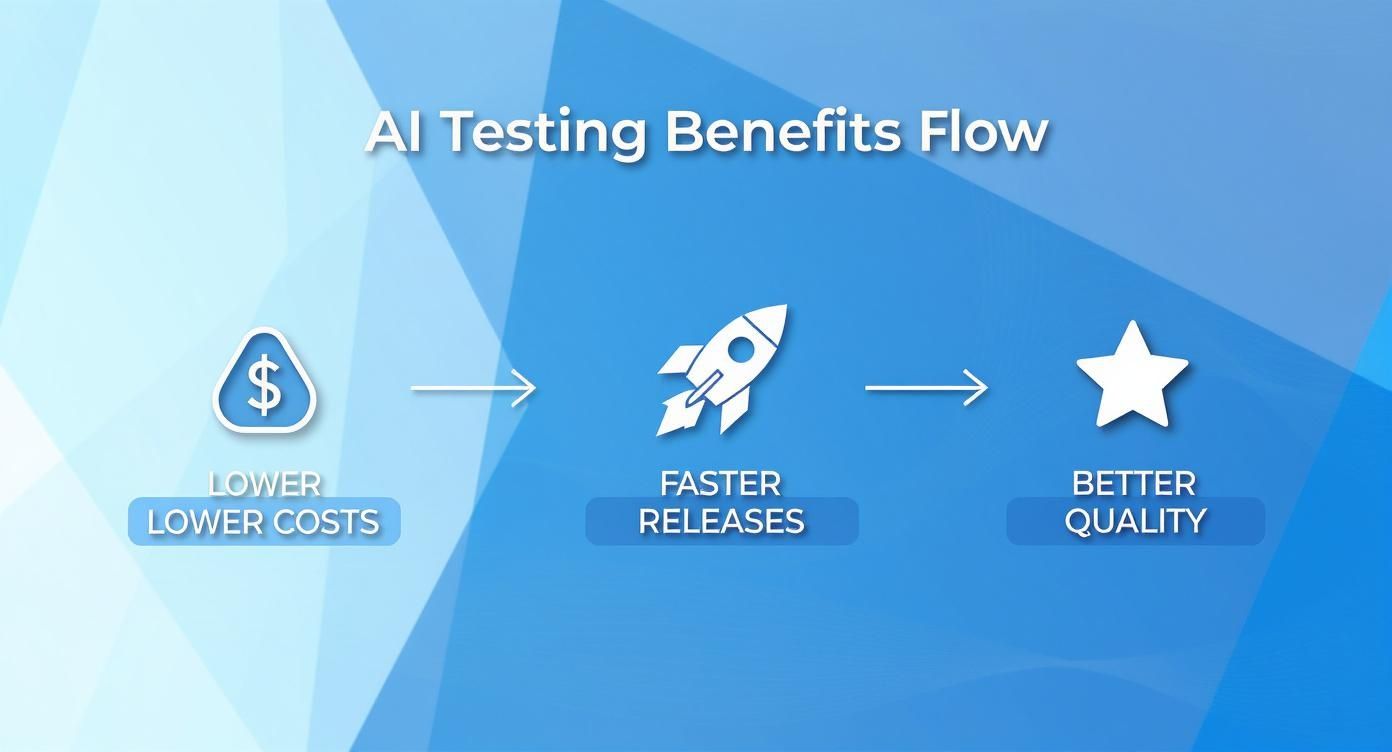
The image makes it clear: each benefit builds on the last, creating a compounding effect on your team’s efficiency and the excellence of your product.
The industry as a whole is moving quickly on this. As of 2024, a staggering 72.3% of testing teams are already exploring or actively using AI-driven workflows. This shift is often a direct response to a shortage of skilled testers, with 38% of organizations using AI to fill that talent gap. This trend goes hand-in-hand with the explosion of DevOps, which grew from 16.9% adoption in 2022 to over 51.8% in 2024, as you can see in the full report on automation trends.

It’s one thing to talk about roadmaps and theories, but seeing artificial intelligence in automation testing actually deliver results is where its real power shines through. When you see how real companies are solving their toughest QA problems, the abstract concepts suddenly become concrete, powerful strategies. These stories aren’t just about cool new tech; they’re about incredible business outcomes.
From massive global retailers to scrappy fintech startups, companies are using AI to ship faster, slash costs, and build a better customer experience. Let’s look at a couple of compelling examples of this happening right now.
Picture a major international e-commerce brand. Millions of people hit their site daily from countless devices, browsers, and screen sizes. For them, ensuring a flawless visual experience was a logistical nightmare. Their manual regression testing was slow, costly, and simply couldn’t keep pace with their constant release cycles.
Their answer was to bring in a Visual AI testing tool. Instead of relying on fragile scripts to check element positions, the AI learned to “see” the application just like a human user would. It could instantly spot even the tiniest visual glitch that would have otherwise gone straight into production.
The results were dramatic:
This case shows how AI shifts quality assurance from a simple “does it work?” check to a full-blown user experience validation. It ensures the product not only functions correctly but also looks perfect on every single screen.
A fast-growing fintech company was drowning in test maintenance. Their mobile banking app was constantly being updated with new features and security fixes. The problem? Every single update broke a huge chunk of their automated test suite. Their QA team was spending more time fixing old, brittle tests than writing new ones, which created a massive bottleneck.
To get out of this rut, they adopted an AI-powered platform with self-healing capabilities. The AI engine was smart enough to recognize when a UI element changed—like a button’s ID or XPath—and could automatically find the new locator and fix the test script on the fly. No human intervention needed.
This completely changed their QA operations. The team cut their test maintenance workload by over 50%, which allowed them to get back to what they were hired to do: improve test coverage for new features. For a company in the high-stakes financial world, this was a game-changer for maintaining quality and security.
If you’re curious about the different platforms that offer these capabilities, our guide on the top AI tools for automated testing is a great place to start.
These real-world examples point to a clear trend. The companies winning with artificial intelligence in automation testing aren’t just buying another tool; they’re embracing a new strategy. They’re solving specific, high-impact business problems by handing over the repetitive and fragile parts of QA to AI, which empowers their teams to focus on what really matters—delivering an exceptional product. At TestDriver, we’re focused on helping teams achieve these exact kinds of wins by making it simple to build robust, AI-driven end-to-end tests.
If you’re wondering what the future holds, let’s be clear: artificial intelligence in automation testing isn’t about replacing human QA professionals. It’s about creating a powerful partnership. The real goal here is to augment our own expertise by handing off the tedious, repetitive, and time-consuming tasks that have always been a drag on testing cycles.
This shift frees up QA engineers to do what we do best—think critically. We can finally dedicate more time to creative problem-solving, deep exploratory testing, and untangling complex user experience puzzles. AI acts as a tireless assistant, handling the grunt work so human ingenuity can drive quality on a much more strategic level.
This human-AI partnership isn’t some far-off concept; it’s already starting to reshape the world of software quality. A few exciting trends are pushing intelligence deeper into the development lifecycle, turning QA from a reactive chore into a proactive discipline.
Here’s a glimpse of what’s just around the corner:
We’re seeing this kind of innovation everywhere, from core testing to related fields, as highlighted in discussions about the future of AI-powered solutions in web accessibility.
The ultimate goal is to create a seamless feedback loop where AI continuously learns from the application, the code, and user behavior to make the entire quality process smarter with every single release.
The takeaway is simple. Adopting artificial intelligence in automation testing is no longer just a nice-to-have for forward-thinking teams; it’s a strategic must. For anyone serious about building better software at the speed business now demands, treating AI as an essential partner is the only way forward.
Jumping into AI-powered testing naturally brings up a lot of questions. As teams look at bringing these tools into their workflow, it’s smart to get a clear picture of what’s what. Let’s tackle some of the most common questions head-on.
We’ll sort through the noise on topics like the future of QA roles, what really separates AI from traditional automation, and the best way to dip your toes in the water.
This is easily the biggest question out there, and the answer is a straightforward no. AI isn’t here to take over jobs; it’s here to supercharge them. It’s brilliant at the grind—running thousands of regression tests, spotting visual glitches, and untangling flaky scripts. This frees up your human experts for work that actually requires a brain.
Human creativity and intuition are still irreplaceable for things like:
The best way to think about it is this: AI becomes your most tireless team member, handling the repetitive tasks so your QA pros can focus on the creative, strategic side of ensuring quality.
It’s a common mix-up, but they’re fundamentally different. Traditional automation is a follower. It executes a rigid script of commands, step-by-step. If a button’s name changes or its location moves, the script breaks. It’s like a factory robot that can only weld one specific spot, over and over again.
AI, on the other hand, brings learning and adaptation into the mix.
An AI-powered system doesn’t just follow a script; it understands intent. It can analyze data, spot patterns, and make intelligent decisions to overcome unexpected changes.
In the world of testing, this means an AI can figure out that a “Submit” button is now labeled “Continue” and adjust on the fly. It can even observe user traffic to generate entirely new test cases—something standard automation just can’t do.
You don’t need to boil the ocean. The best approach is to start small and prove the value with a focused pilot project. Pick a known trouble spot—maybe a part of your app with tests that are constantly breaking or a user flow that changes with every release.
By aiming an AI tool at a single, high-impact area first, you can:
This step-by-step method makes adoption feel manageable and sets you up for a much smoother rollout when you’re ready to expand.
Ready to see how an AI agent can transform your QA process? TestDriver helps you generate end-to-end tests for any app or website with a simple prompt, turning your intent into executable tests in minutes. Explore TestDriver’s AI capabilities.
Discover the 12 best codeless automation testing tools for web, API, and mobile. Our 2026 guide helps you choose the right platform for your QA workflow.
Discover how automated user interface testing boosts software quality and speed. This guide covers everything from core concepts to CI/CD and AI.
Discover how automated functional tests can transform your QA process. Learn core concepts, best practices, and how AI is making test creation faster than ever.
Build a reliable strategy for automated regression tests. Learn to prevent bugs, speed up releases, and integrate testing seamlessly into your CI/CD pipeline.
TestDriver runs every pull request in a real desktop sandbox, finds bugs, and builds regression tests - right from your repo.