10 Test Automation Best Practices for 2025
Discover 10 essential test automation best practices to enhance your QA strategy. Learn about POM, CI/CD, flaky test management, and more.
Explore our complete guide to automated testing as a service (ATaaS). Learn how it works, its key benefits, and how to implement a successful strategy.
Automate and scale manual testing with AI ->
So, what exactly is Automated Testing as a Service (ATaaS)? Think of it as a cloud-based subscription that gives your team on-demand access to a whole universe of testing tools and infrastructure. Instead of sinking a ton of cash into building and maintaining your own testing environment, you simply rent the resources you need, when you need them.
This pay-as-you-go approach lets companies get their software out the door faster and with higher quality, all without the headache of managing the underlying hardware and software.
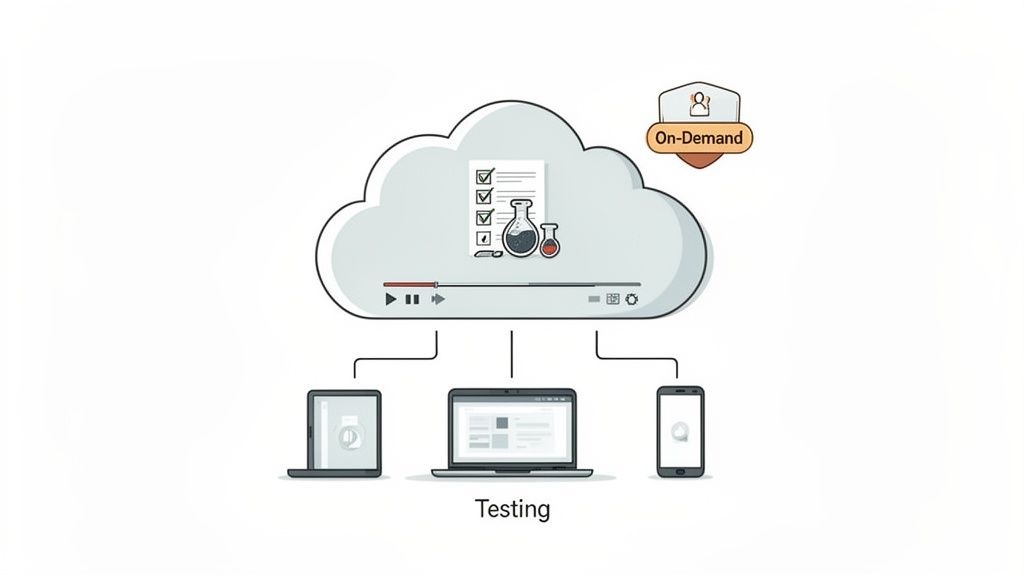
The best way to think about ATaaS is to compare it to a streaming service. You wouldn’t go out and buy a massive library of DVDs and all the players to watch them on, right? You’d just subscribe to a service that gives you instant access to everything you want to watch.
It’s the same idea with automated testing as a service. You get to skip the huge upfront costs of physical servers, expensive software licenses, and hiring a team just to manage it all.
The real magic here is outsourcing the complexity. Your developers can keep their focus on what they do best—building great products—instead of getting bogged down managing a complicated test grid. The ATaaS provider takes care of everything behind the scenes: the infrastructure, the maintenance, scaling up or down, and keeping all the tools updated.
This service model really flips the script on how teams handle quality assurance. It bundles a few critical elements into a single, easy-to-use platform:
The big idea is to turn QA from a slow, expensive bottleneck into a flexible, on-demand service. This lets companies of any size get the kind of deep test coverage that used to be possible only for massive enterprises.
At the end of the day, ATaaS makes powerful testing capabilities available to everyone. And with AI-driven platforms now in the mix, it’s becoming even easier. Teams can generate complex tests from simple text descriptions, cementing automated testing as a service as a must-have for any modern, agile team.
So, how does all this automated testing as a service stuff actually work behind the scenes? It’s helpful to peek under the hood to see why it’s so valuable. Think of an ATaaS platform as a complete testing ecosystem that plugs right into your existing development process, taking all the messy infrastructure management off your plate.
The market growth tells the story. The global Testing as a Service market was already valued at USD 4.54 billion in 2023, and it’s expected to jump to USD 11.38 billion by 2030. That’s a huge leap, and it’s happening because more and more companies are realizing they can’t build or scale this kind of infrastructure in-house. You can see the full breakdown on Grand View Research. This isn’t just a trend; it’s a fundamental shift in how teams approach quality.
Most ATaaS platforms are built around three key parts that work in harmony. Each piece handles a specific job, moving your tests from a simple script to a full-blown report.
The “as a service” part is the real magic here. The provider handles all the maintenance, updates, and configuration of this entire setup. Your team gets access to a world-class testing lab without ever touching a server.
Let’s walk through a real-world example. A developer just finished coding a new login page. Instead of bugging a QA engineer to test it manually, they can use a platform like TestDriver and write a simple instruction: “Verify a user can log in with valid credentials and sees an error with invalid ones.”
From there, the ATaaS platform takes over.
An API call from a CI/CD tool like GitHub Actions signals the platform to get to work. It instantly grabs the necessary virtual browsers from its cloud grid and runs the test against the developer’s new code, checking every step of the process.
In just a few minutes, the results are back—a clear pass or fail, packed with all the diagnostic data needed to fix any issues. The developer sees this feedback right away, without ever leaving their workflow. This is how ATaaS turns testing from a bottleneck into an integrated, automated part of building software. Seeing what’s possible with TestDriver’s full set of AI-powered features shows just how simple this process can be.
Let’s move past the theory and talk about what really matters: how automated testing as a service actually helps your team ship better software, faster. The advantages aren’t just minor tweaks; they solve some of the biggest headaches in modern development, from runaway budgets to slow release cycles.
There’s a reason why the automation testing market is exploding. It was valued at a massive USD 28.1 billion in 2023 and is on track to nearly double, hitting USD 55.2 billion by 2028. Companies are increasingly turning to outside experts to get a faster return on their investment. In fact, some teams have seen their feedback loops get up to 70% faster after making the switch. You can dig into the numbers yourself in this detailed industry report.
At its core, ATaaS simplifies a complex process into a clean, straightforward workflow.
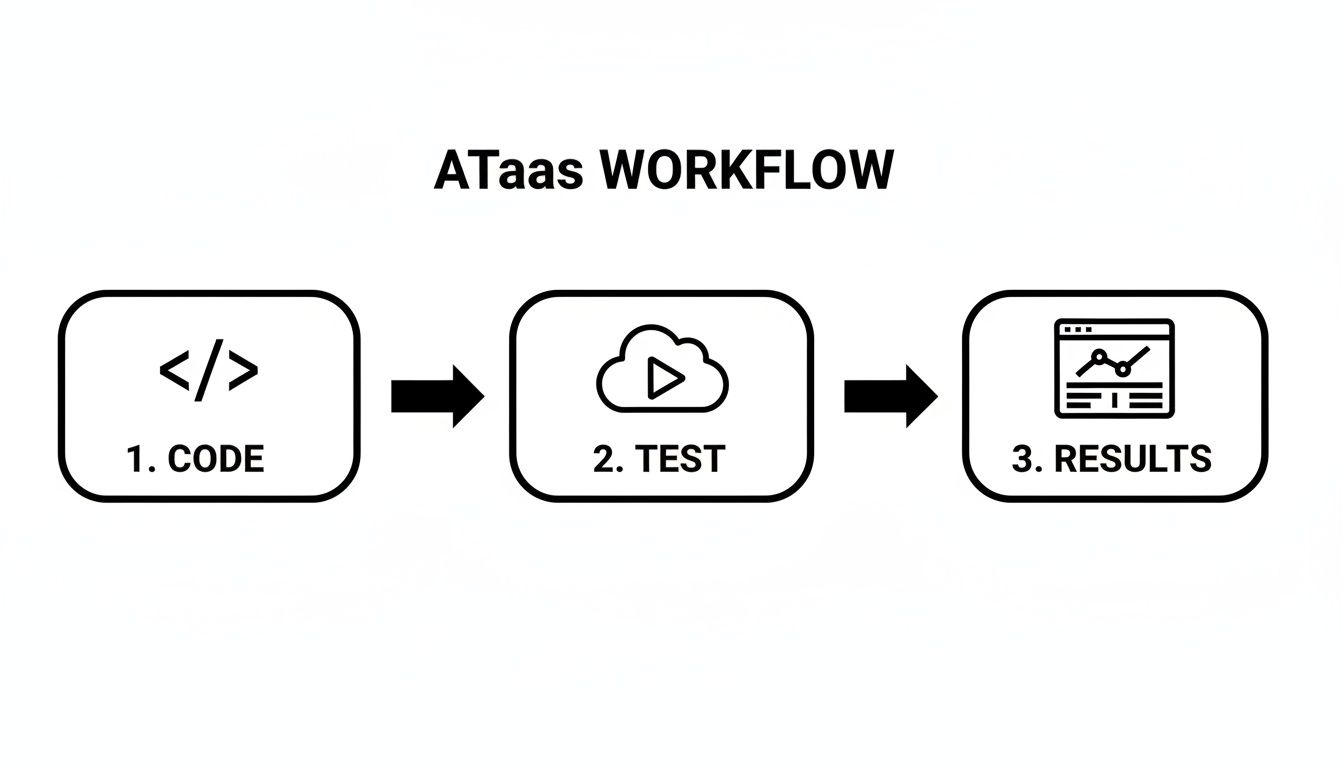
This simple loop—from code commit to automated testing and clear results—is where the magic happens.
The first and most obvious win is financial. Setting up a proper in-house testing grid is a huge capital expense. You’re buying servers, paying for software licenses, and dedicating staff time just to maintain it all.
ATaaS flips that model on its head. It turns a large, unpredictable capital expense into a manageable, predictable operational cost. No more surprise maintenance bills or costly hardware upgrades. This also opens the door to using dedicated cloud cost optimization tools to further manage your spending.
Deciding between building your own setup and subscribing to a service can be tough. This table breaks down the key differences to help you see where the value lies.
| Aspect | In-House Automation | Automated Testing as a Service (ATaaS) |
|---|---|---|
| Initial Cost | High (Servers, software licenses, setup) | Low (Subscription-based, no upfront hardware) |
| Ongoing Costs | Variable (Maintenance, upgrades, electricity, staff) | Predictable (Fixed monthly/annual subscription fees) |
| Scalability | Limited by physical hardware and budget | Virtually Unlimited (On-demand access to cloud grid) |
| Expertise | Required (Dedicated team for setup & maintenance) | Included (Managed by vendor experts) |
| Device/Browser Coverage | Limited (Must purchase and configure each one) | Extensive (Instant access to hundreds of combinations) |
| Time to Value | Slow (Months to build and stabilize) | Fast (Can start running tests within minutes) |
As you can see, the ATaaS model is built for speed and efficiency, offloading the infrastructure burden so your team can focus on what they do best: building a great product.
Think about a full regression suite that takes your team 10 hours to run on a single machine. That’s a huge bottleneck. With ATaaS, you can take that same suite and run all the tests in parallel across hundreds of different cloud environments at the same time.
This parallel execution can shrink a 10-hour test run down to just 15 minutes. This isn’t just a small improvement; it’s a fundamental change to your development cycle. It means developers find out about bugs almost immediately, not hours later.
This raw speed directly translates into a faster time-to-market. You can release new features and critical updates with much greater confidence and frequency.
Finally, ATaaS gives you a massive device lab and a team of experts without adding a single person to your payroll. The provider handles all the tricky parts of maintaining a modern test grid.
By handing off the operational heavy lifting, automated testing as a service empowers your team to achieve better test coverage and faster release cycles, no matter the size of your company.
Picking an automated testing as a service provider is more like entering a long-term partnership than just buying a piece of software. The right partner can seriously speed up your development cycles. The wrong one? It can become a source of new headaches, bottlenecks, and even security vulnerabilities. To get it right, you have to look past the marketing hype and really dig into the fundamentals that matter: reliability, security, and how well it plays with your existing tools.
This means asking some tough questions and not being shy about getting into the weeds. Not every platform is built the same, and what’s perfect for a nimble startup might completely fail to meet the compliance standards of a large enterprise.
Let’s start with the absolute deal-breaker: security. You’re about to hand over your application code and potentially sensitive test data to a third party. You need to have total confidence in their ability to protect it. Don’t just accept their claims at face value; demand proof.
Here’s what to look for:
A provider’s security posture isn’t a feature on a checklist; it’s the very foundation of your trust. If they can’t give you a clear, confident answer on how they protect your test environments and data, it’s a major red flag.
An ATaaS platform is only valuable if it slots neatly into your team’s existing workflow. If adopting a new tool forces everyone to completely change how they work, you’ll be fighting an uphill battle for adoption from day one. The best solutions feel like a natural extension of the tools you already rely on.
This means you need to hunt for deep, native integrations with the software your team lives in every day. Check for compatibility with:
This is just one piece of the puzzle. You can get a broader perspective by reading our guide on how to choose the right tools for software testing.
Finally, you need to know what promises the provider is willing to make—and put in writing. A Service Level Agreement (SLA) is the contract that spells out exactly what you can expect from them. It’s your safety net, defining guarantees for uptime, performance, and how quickly they’ll respond when things go wrong.
When you get your hands on the SLA, don’t just skim it. Ask pointed questions:
A solid, transparent SLA is a sign of a mature provider that stands behind its service and is ready to be held accountable.
So, how do you actually bring automated testing as a service into your organization? The good news is that you don’t have to rip and replace your entire development process. The trick is to start small, show real value quickly, and let the results speak for themselves.
Think of it as an evolution, not a revolution. By rolling out ATaaS in phases, you give your team time to adapt and see the benefits firsthand. When done right, it won’t feel like another tool being forced on them; it will feel like a natural, logical upgrade to how you build and ship software.
The best first step is always a pilot project. Pick one well-defined, manageable part of your application to test the waters. This keeps the risk low and gives you a controlled environment to learn the ropes of your new ATaaS platform.
What makes a good pilot project? Look for something critical but not overly complex.
Focusing on a narrow scope lets you score a quick win. That success story becomes your internal proof-of-concept, making it much easier to get buy-in for expanding ATaaS to other teams and projects.
With a pilot project in hand, it’s time for a clear, focused strategy. Don’t fall into the trap of trying to automate everything all at once. The initial goal should be to get the most bang for your buck, and for most teams, that means starting with high-value regression tests.
Think of it this way: Your first priority is to build a safety net. Automate the tests that confirm your most critical features haven’t broken after a new code change. This provides immediate value by reducing risk and building confidence in every release.
Once that safety net is in place, you can start expanding. As your team gets more comfortable with the platform, you can branch out into other types of testing. The key is to be deliberate and prioritize impact from day one.
This is where ATaaS really shines. By plugging it directly into your CI/CD pipeline, you create a fully automated feedback loop. Tests run automatically every time a developer pushes new code, giving them feedback in minutes, not hours or days. To dive deeper, check out these best practices for integrating testing into your CI/CD pipeline.
Connecting your ATaaS platform is usually surprisingly simple. Often, it just means adding a few lines of code to your pipeline configuration file. For instance, if you wanted to trigger a test suite in a tool like TestDriver, you could add a simple API call to your GitHub Actions workflow.
- name: Run TestDriver E2E Tests
  run: |
    curl -X POST \
      -H "Authorization: Bearer ${{ secrets.TESTDRIVER_API_KEY }}" \
      -H "Content-Type: application/json" \
      -d '{ "suiteId": "your-suite-id" }' \
      https://api.testdriver.ai/v1/runs
Just like that, automated testing as a service becomes a seamless, hands-off part of your deployment process, catching bugs before they ever reach production.
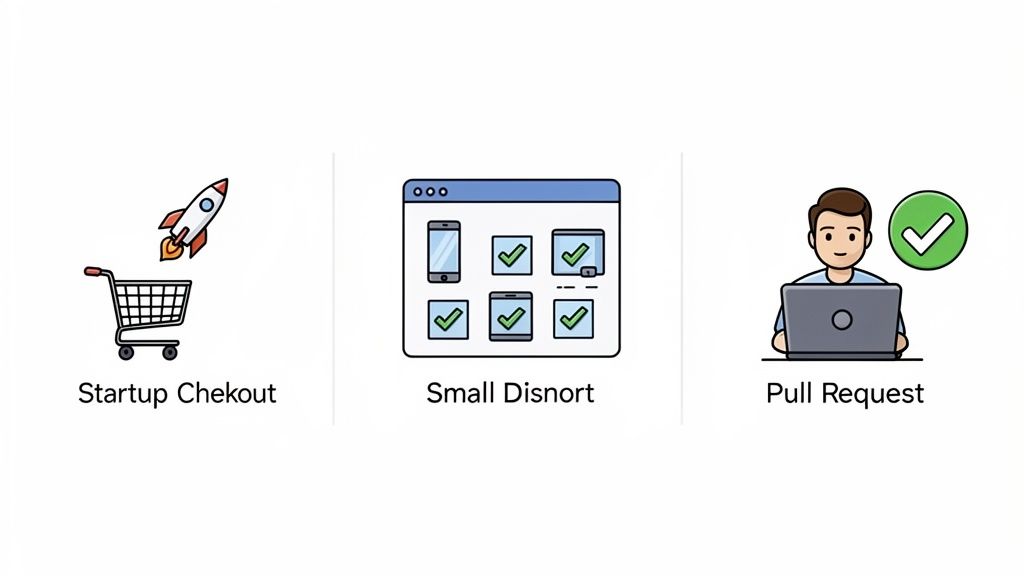
The theory behind automated testing as a service is great, but its real power clicks into place when you see it solving genuine, everyday business problems. Let’s walk through a few common situations where ATaaS becomes a total game-changer, saving teams a ton of time, money, and headaches.
Picture a startup that’s growing fast and gearing up for a huge product launch. Their engineering team is already maxed out, but the e-commerce checkout flow has to be absolutely perfect. Instead of bogging everyone down with manual tests, the product manager can turn to an AI-powered tool like TestDriver.
All they have to do is write a simple, plain-language prompt, like: “Test that a user can add an item to the cart, apply a coupon, and complete the checkout using a credit card.” The ATaaS platform takes that instruction and immediately translates it into a real, executable test, verifying the entire critical path without anyone needing to lift a finger.
Here’s another classic scenario. A SaaS company needs to guarantee their web app works flawlessly across a huge matrix of browsers, operating systems, and devices. Trying to build and maintain an in-house lab for all those configurations would be a logistical and financial nightmare. This is where ATaaS really shines.
With just a few clicks, the team can unleash their entire test suite across a massive cloud grid of real and virtual environments. This is how you catch those obscure bugs—the ones that only pop up for users on a specific version of Firefox running on macOS—long before they ever affect a paying customer.
The core benefit here is confidence. Teams can ship updates knowing their application will deliver a consistent, high-quality experience for every single user, no matter how they access it. Achieving that kind of broad coverage without an ATaaS solution is nearly impossible to do cost-effectively.
Finally, let’s look at a busy dev team practicing continuous integration. A key strength of ATaaS platforms is their knack for integrating automated testing into CI/CD pipelines.
Once integrated, a full suite of regression tests can be kicked off automatically with every single pull request. This gives developers instant feedback, telling them if their recent changes accidentally broke something else. Bugs are caught and fixed in minutes, not days, stopping them from ever making it into the main codebase. This “shift-left” approach simply makes the whole development cycle faster and far more stable.
Jumping into any new service, especially something as core to your workflow as Automated Testing as a Service, is going to come with questions. Let’s walk through some of the big ones we hear all the time so you can get a clearer picture.
This is, without a doubt, the number one concern for most teams—and it should be. Handing over access to your application and data isn’t a small decision.
Top-tier ATaaS providers know this and build their platforms on a foundation of security. Your code, test data, and results are never just sitting out in the open. They’re protected with layers of security measures.
If you’re building with frameworks like React, Vue, or Angular, you know how tricky they can be for traditional test automation. Content loads dynamically, elements appear and disappear, and old-school test scripts break constantly. It’s frustrating.
This is exactly where a modern Automated Testing as a Service platform shines. They were built for the complexities of today’s web. Instead of relying on brittle selectors, they use smarter ways to find elements and have built-in “adaptive waits” that patiently wait for your app to catch up before proceeding. The result? Tests that are stable and reliable, not flaky.
A platform’s ability to intelligently adapt to your application’s behavior is what separates a modern solution from older, more brittle automation frameworks. This adaptability is key to getting trustworthy results.
ATaaS isn’t meant to be a separate, siloed tool. It’s designed to snap right into your DevOps and CI/CD pipeline, making continuous testing a reality.
By integrating the service with your pipeline (think Jenkins, GitHub Actions, etc.), you can automatically trigger a full suite of tests every time a developer commits new code. This is a game-changer for “shifting left”—finding bugs moments after they’re created, not weeks later in a QA cycle.
This tight integration provides instant feedback directly to your developers. It essentially creates an automated quality gate, ensuring only well-tested code ever makes its way toward production.
Ready to see how AI can accelerate your testing process? With TestDriver, you can generate comprehensive end-to-end tests from simple text prompts, freeing your team to focus on building great software. Get started today with TestDriver.
Discover 10 essential test automation best practices to enhance your QA strategy. Learn about POM, CI/CD, flaky test management, and more.
Discover how automated functional tests can transform your QA process. Learn core concepts, best practices, and how AI is making test creation faster than ever.
Build a reliable strategy for automated regression tests. Learn to prevent bugs, speed up releases, and integrate testing seamlessly into your CI/CD pipeline.
Explore our guide to UI automation testing. Learn core concepts, how to build stable tests, and integrate AI for faster, more reliable software releases.
TestDriver runs every pull request in a real desktop sandbox, finds bugs, and builds regression tests - right from your repo.