A Practical Guide to Modern Test Strategy Documents
Stop writing test strategy documents no one reads. This guide offers actionable advice and proven frameworks to create living strategies that align your team.
Clearly understand the difference in the test plan vs test strategy in software testing. This guide covers roles, scope, and when to use each for better QA.
Automate and scale manual testing with AI ->
When talking about a test plan vs test strategy in software testing, we’re really getting at the difference between the “why” and the “what.” A test strategy is the high-level thinking—the guiding philosophy for quality across your entire organization. In contrast, a test plan is the tactical, on-the-ground document that spells out the testing for one specific project.
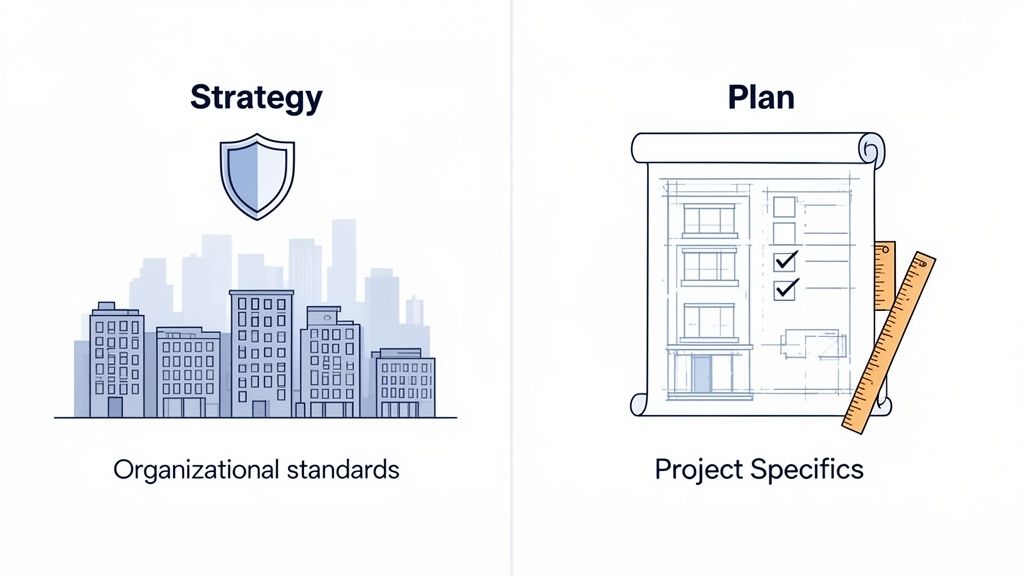
It’s pretty common for teams to use these terms interchangeably, but that’s a recipe for confusion and missed expectations. Getting the distinction right is fundamental to building a solid, repeatable testing process. The strategy lays the foundation, and the plan builds the house on top of it.
Here’s a practical way to think about it: imagine you’re building a new city.
Your test strategy is like the city’s master plan or its core architectural philosophy. It sets the standards for everything: all new buildings must be earthquake-resistant, use sustainable materials, and be energy-efficient. This is a long-term document that doesn’t change often and applies to every single construction project.
The test plan, on the other hand, is the specific blueprint for one skyscraper in that city. It gets into the weeds—listing the exact materials, timelines, resources, and structural tests for that building alone. It has to follow the city’s master plan, but it’s unique to the project. You’d create a new test plan for every building you put up.
This fundamental difference in scope trickles down into everything, from who writes the document to how often it gets a refresh. The table below cuts right to the chase, breaking down the key distinctions.
| Attribute | Test Strategy (The Guiding Principles) | Test Plan (The Actionable Blueprint) |
|---|---|---|
| Purpose | Defines the organization’s overarching approach to testing and quality assurance. | Details the specific testing activities for a particular project or release. |
| Scope | Organizational or product-line level; applies to multiple projects. | Project or feature-specific; scope is limited to a single release. |
| Focus | Answers the “Why” and “How” at a high level (e.g., our approach to automation). | Answers the “What, When, Who” for a project (e.g., what features to test). |
| Lifespan | Long-term and relatively static; updated infrequently (e.g., annually). | Short-term and dynamic; updated frequently as the project evolves. |
| Ownership | Typically owned by a QA Manager, Architect, or senior QA leadership. | Typically owned by a Test Lead or Project Manager. |
| Content | Includes test levels, methodologies, tool standards, and risk frameworks. | Includes scope, schedules, resources, entry/exit criteria, and test deliverables. |
Having this clear separation helps everyone know their role and how their work fits into the bigger quality picture. For a deeper look at the world of QA, our guide on understanding software testing is a great place to start.
Think of a test strategy as the constitution for your entire QA organization. It’s the high-level, guiding document that establishes the standards for quality, not just for one project, but for everything you do. Unlike a project-specific test plan, the strategy provides the overarching philosophy and principles that govern testing across the board.
At its core, this document is all about tying your quality efforts directly to business objectives. It takes broad company goals—like boosting customer retention or capturing more market share—and translates them into tangible QA principles. It defines the non-negotiables of how you approach testing.
A solid test strategy is intentionally broad and relatively static. It isn’t bogged down by the daily specifics of testing a single feature. Instead, it answers the foundational questions that bring stability and consistency to every team.
Key elements you’ll typically find in a test strategy include:
This strategic document is usually owned by senior leadership, like a QA Director or a Head of Testing. It’s reviewed periodically—maybe once a year—not every week. Its long-term nature ensures that even as teams and projects shift, the fundamental commitment to quality never wavers.
A well-defined test strategy ensures that tactical, project-level decisions always serve a larger, unified vision of quality. It prevents teams from operating in silos and reinventing the wheel for every new release cycle.
For example, a strategic goal to “increase automated regression coverage by 50% over the next year” has direct implications. It pushes the organization to adopt more efficient solutions and find better ways to work. You can explore our guide on some essential testing strategies for quality assurance to get more ideas.
The real power of a test strategy shines when it guides the adoption of new technologies and methodologies. Industry insights on testing methodologies from testdevlab.com show that organizations with both a test strategy and a test plan see much better testing outcomes. For teams moving to automated platforms like TestDriver, a clear strategy ensures that AI-powered test generation aligns perfectly with the organization’s quality goals. The test plan then details how those automated tests will be executed, scheduled, and validated for each specific release.
Imagine a strategy that mandates a shift toward AI-driven testing to speed up release cycles. That high-level objective doesn’t get into the weeds of how a single project will do it. Instead, it empowers a Test Lead to write a test plan that explicitly includes using an AI agent like TestDriver to generate end-to-end tests for a new user checkout flow.
The strategy provides the “why” (we need to be faster and more efficient), while the plan details the “how” (we will use TestDriver to automate these specific scenarios). This creates a direct, traceable line from a high-level business goal all the way down to a single testing task, making sure every action contributes to the company’s bigger quality mission.
If you think of a test strategy as the company’s constitution for quality assurance, then the test plan is the specific law passed for a single project. It’s the tactical, hands-on document that takes those big-picture strategic goals and turns them into concrete, day-to-day actions. While the strategy gives you the “why,” the test plan lays out the “what, when, who, and how” for a specific software release.
This document is the operational blueprint for the QA team. It’s designed to eliminate guesswork, making sure every team member knows their exact responsibilities, the scope of their work, and what success looks like. Unlike the long-term, mostly static nature of a strategy, a test plan is a dynamic, living document that adapts to the project’s needs.
A test plan’s main job is to put the principles from the test strategy into practice. For instance, if the strategy says, “all critical user workflows must have automated regression tests,” the test plan for a new mobile banking app would get specific. It would pinpoint exactly which workflows are considered critical for this release.
From there, it would break down that strategic goal into an executable project with these key components:
A great test plan acts as the single source of truth for a project’s entire testing effort. It gets all the stakeholders on the same page, guides the QA team’s daily work, and creates a clear framework for measuring progress.
Let’s imagine a team is about to launch a new mobile banking feature that lets users deposit checks by taking a photo. The Test Manager or Test Lead would craft a dedicated test plan just for this feature. This plan takes the organization’s high-level test strategy and applies it directly to this project. For a closer look at this process, check out our guide on understanding modern test planning in Agile development.
The plan might state that testing for the check deposit feature will kick off on Monday of Sprint 4 and must wrap up by Friday of Sprint 5. It would assign two specific QA engineers to run both the manual and automated test suites. Critically, it would define the exit criteria: the feature is only considered release-ready when there are zero blocker defects and fewer than five minor UI bugs.
As the project moves forward and new requirements pop up, the Test Lead continuously updates this document. It becomes a dynamic guide that always reflects the project’s current reality, which is a world away from the test strategy, which remains consistent in the background, providing stable governance.
While we know a test strategy sets the high-level vision and a test plan details the project-specific actions, the real differences pop up when you compare them on the ground, in the middle of a project. Going beyond textbook definitions helps us see how each document actually works in a QA team, showing their unique jobs, lifespans, and who’s responsible for them.
Comparing a test plan vs a test strategy in software testing isn’t just an academic exercise; it directly shapes how teams spend money, manage deadlines, and decide what “success” looks like. Each one speaks to a different audience and solves a completely different set of problems.
This flowchart breaks down the core pieces you’ll typically find inside a test plan: the scope, schedule, and resources.
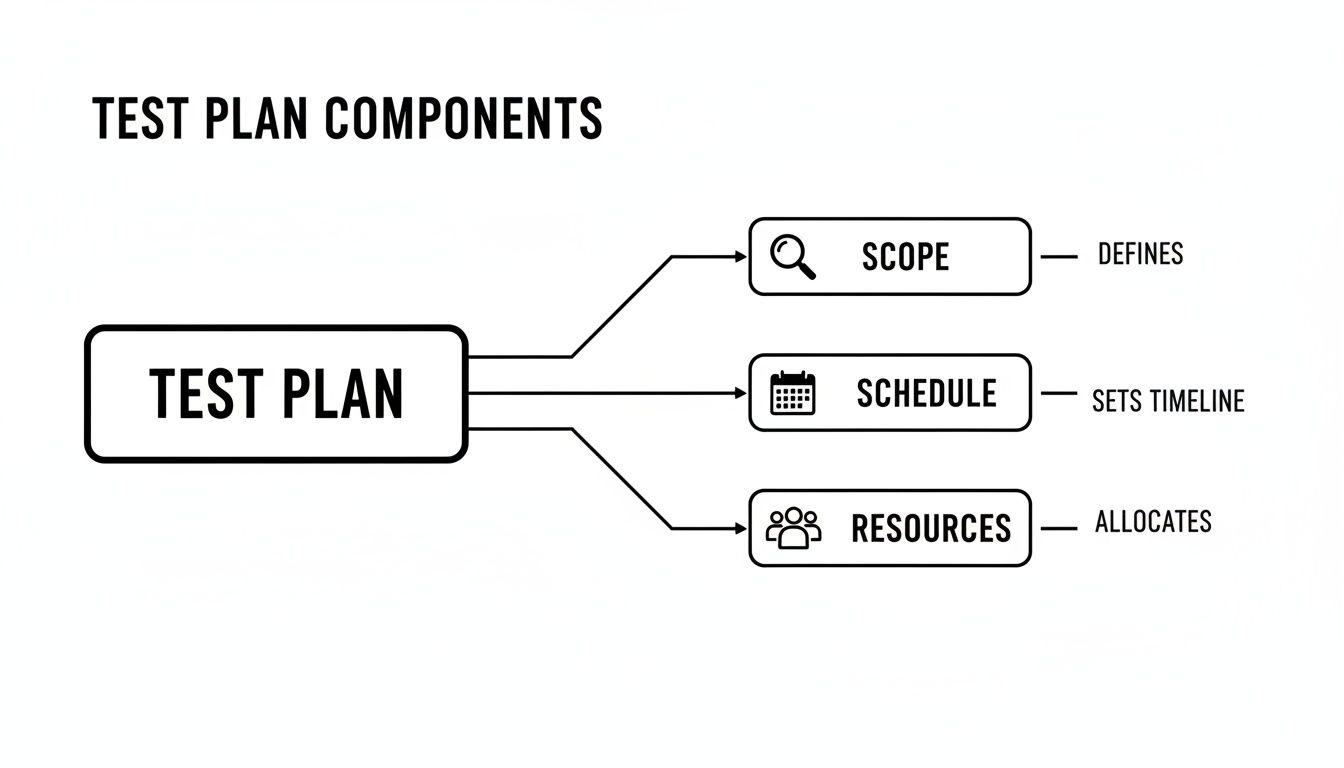
As you can see, a test plan is all about the specifics. It’s the document that turns broad strategic goals into tangible, day-to-day work for the team.
To truly understand how they coexist, let’s put the test strategy and test plan side-by-side and examine them across several key attributes. This table gives a quick, high-level look at their distinct roles.
| Attribute | Test Strategy | Test Plan |
|---|---|---|
| Scope | Organizational or product-line level. It’s the “how we test” blueprint for the entire company. | Project or release-specific. It’s the “what we’ll test” for this one feature or update. |
| Focus | High-level principles, approaches, and guiding rules. Think philosophies and standards. | Specific, actionable tasks, schedules, and resource assignments. Think to-do lists and logistics. |
| Lifespan | Long-term and relatively static. It’s built to last for years, updated only with major company shifts. | Short-term and dynamic. It lives and dies with the project, often updated weekly or even daily. |
| Ownership | Senior leadership (QA Director, Head of Engineering). They focus on governance and consistency. | Project leadership (Test Manager, QA Lead). They focus on execution and delivery. |
| Artifacts | Quality standards, risk management policies, tool selection guidelines, test environment specs. | Test scope, feature list, schedule, defect tracking procedures, entry/exit criteria. |
| Example | ”All new APIs must undergo security penetration testing before production deployment." | "For the v2.1 release, the new payment API will be tested using OWASP ZAP, with results due by Oct 15.” |
This comparison makes it clear that one document can’t do the job of the other. The strategy provides the guardrails, while the plan maps out the specific route for the journey ahead.
The most fundamental difference is their scope. A test strategy operates at the organizational or product-line level. It’s designed to be a consistent quality framework that applies to every project the company builds, no matter the team.
A test plan, on the other hand, is laser-focused on a single project or release. Its scope is tightly defined, detailing the testing for a specific set of features, like a new user login system or a shopping cart redesign.
The test strategy is the rulebook for the entire league; the test plan is the game plan for a single match.
This separation is vital. The strategy ensures that every team adheres to the same quality standards, uses approved tools, and follows the same risk protocols. The plan then takes those rules and applies them to the unique challenges of its specific project.
The level of detail in each document is also worlds apart. A test strategy deals in high-level principles and guidelines. It might say, “All customer-facing apps must undergo performance testing to handle 1,000 concurrent users.” It sets the bar.
The test plan takes that principle and breaks it down into concrete, actionable tasks. It would specify which performance testing tool to use, the exact user scenarios to simulate, the hardware for the test environment, and the precise metrics to hit (e.g., response time under 2 seconds).
A strategy provides the guiding philosophy (“what we believe in”), while a plan provides the executable instructions (“what we will do”).
This distinction keeps the strategy from getting bogged down in project-specific details that would make it obsolete in a month. At the same time, it gives the test plan enough concrete detail to guide a QA engineer’s daily work without any guesswork.
The lifespan of these documents is a direct reflection of their scope. A test strategy is a long-term asset, built to be relatively static. It provides stability and is typically reviewed only occasionally—maybe once a year or when a major organizational change happens.
In contrast, a test plan is a short-term, living document. It’s created for one project and might get updated multiple times within a single sprint as requirements evolve or timelines shift. Once the project ships, the test plan is archived.
A test strategy is built to last for years; a test plan is built to last for a single release cycle.
For example, a QA Architect might revisit the company’s test strategy annually to align it with new business goals. A Test Lead, however, could be updating their project’s test plan every single week to reflect the team’s progress and challenges.
Finally, who owns them is a key differentiator. The test strategy is typically owned by senior leadership in the quality organization—think a QA Director, QA Architect, or Head of Engineering. Their focus is on high-level governance and ensuring quality is consistent across the board.
The test plan is owned by someone much closer to the action, usually a Test Manager or Test Lead. Their job is tactical: to make sure the testing for their project gets planned, executed, and reported on effectively, all while following the rules laid out in the strategy. This push toward formalized testing is growing; recent data shows that between 65-75% of large companies now use documented test strategies, a huge jump from around 45% in 2015. You can find more on this trend in BrowserStack’s guide to test strategies.
Strategic ownership focuses on governance and standards; tactical ownership focuses on project delivery and execution.
This split ensures that high-level quality goals are maintained across the company, while project teams still have the freedom to plan and test in a way that makes sense for their specific needs.
Knowing the difference between a test plan and a test strategy is half the battle. The other half is actually creating documents that your team will use. These aren’t just bureaucratic checkboxes; they’re the frameworks that guide your entire quality assurance effort, connecting high-level business goals to the individual test cases your team runs every day.
Without them, testing can quickly become a chaotic, inefficient mess that feels disconnected from what the business actually needs. Creating these documents takes a structured approach. Think of the test strategy as your long-term vision for quality, and the test plan as the concrete, project-specific roadmap to get there.
Let’s walk through how to build both so they provide real, practical value.
A test strategy is the high-level rulebook for your organization’s entire approach to testing. It’s a fairly static document meant to be the “North Star” for quality, ensuring every project follows the same core principles.
A solid test strategy template should always cover these key areas:
If the strategy sets the rules of the game, the test plan is the specific game plan for a single project. It’s a living document, tailored to a particular release or feature, that turns those strategic goals into actionable tasks.
A comprehensive test plan template should include:
A well-structured test strategy and plan are not just about documentation; they are about alignment. They ensure that every testing activity, from a high-level policy decision to a single test case execution, directly supports the project’s and the company’s goals.
The financial and operational impact of getting this right is huge. Beyond just saving money, organizations with documented test strategies shorten their average release cycle time by 15-22 days. For teams using modern tools, a formal strategy is even more critical. When implementing AI-powered testing solutions, it establishes the clear quality thresholds an AI agent can optimize against, which can cut manual test creation time by 60-75% while keeping everything aligned. You can dig deeper into the benefits of a formalized approach in this PractiTest article.
This structured approach is what connects your high-level quality philosophy to the day-to-day work, making your entire testing process more purposeful and effective.
So, when do you need a test plan versus a test strategy? The real answer isn’t about which is “better,” but which one fits your team and project right now. The whole test plan vs test strategy in software testing debate boils down to context: your project’s complexity, the size of your team, and how mature your organization’s processes are.
Forget a one-size-fits-all solution. The goal is to find the right level of documentation for your specific situation—enough to ensure quality without bogging you down in unnecessary paperwork.
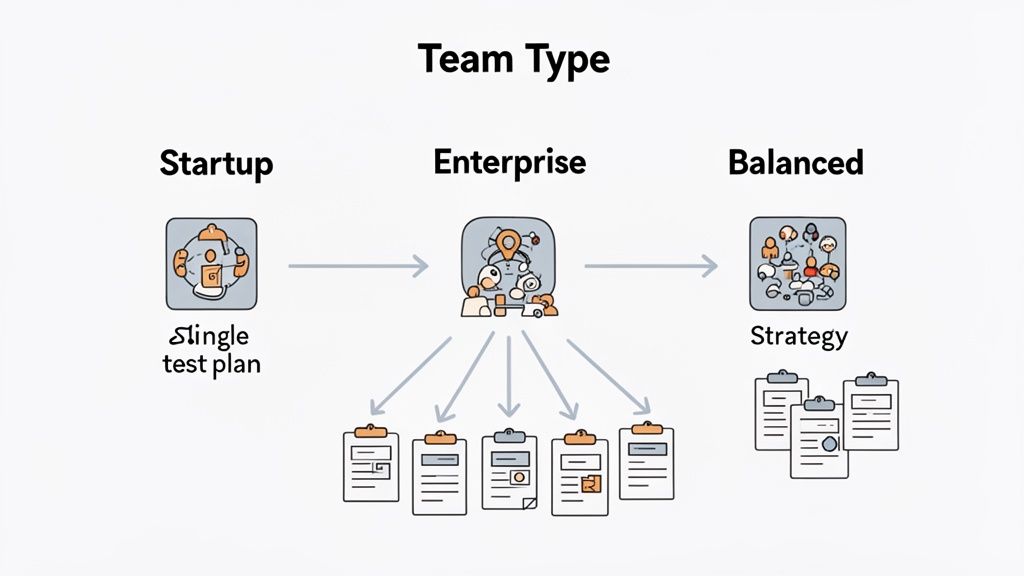
Let’s look at how this plays out in the real world.
Most QA teams find themselves in one of three common situations. Each one calls for a different approach.
This hybrid approach is powerful because it keeps the day-to-day work perfectly aligned with the big-picture goals. The strategy gives you the “why,” while the individual test plans give you the “how” for each project, creating a quality framework that’s both consistent and scalable.
In the end, it’s about creating just enough process to deliver a quality product without killing your team’s momentum. A startup can get by just fine with a single, detailed test plan for its launch. But as that company grows, a test strategy becomes essential for maintaining that quality across new teams and products. The key is to be honest about your needs and pick the documentation that brings clarity, not clutter.
Let’s clear up a few common questions that always seem to pop up when people are trying to untangle test plans from test strategies. Getting these distinctions right can save a lot of headaches down the road.
Technically, yes. You’ll often see this in small teams or early-stage startups where things are moving fast and a detailed plan is all they have time for. The test plan essentially pulls double duty, guiding all testing for a specific project.
But this approach doesn’t scale well. Without a guiding strategy, you’ll eventually run into problems like inconsistent testing across different projects, wasted effort on redundant tests, and a real disconnect between what QA is doing and what the business actually needs. The strategy is the high-level playbook that makes sure every individual plan contributes to the same quality goals.
The approval process for each document really tells the story of its scope and impact.
Think of it this way: The test strategy is a governance document approved by leadership. The test plan is an operational document approved by the project team. This keeps high-level standards in place while giving project teams the autonomy to execute.
A good test strategy is built to last. It’s a relatively static document you’ll revisit, but not constantly change. Plan on reviewing it annually or whenever a major shift happens—like a new technology stack is adopted or the company’s business goals change.
A test plan, on the other hand, is a living document. It’s constantly evolving with the project, often getting updated weekly or even daily as new information comes to light and priorities shift.
Understanding these documents is the first step, but executing them efficiently is what really matters. Modern tools can bridge that gap. TestDriver, for example, helps your team translate the detailed objectives from your test plan into action by using AI to generate end-to-end tests in minutes.
You can close the loop between planning and execution much faster. See how it works by visiting the official TestDriver website.
Stop writing test strategy documents no one reads. This guide offers actionable advice and proven frameworks to create living strategies that align your team.
Explore our definitive guide on white box vs black box testing. Learn key differences, practical applications, and how to choose the right strategy.
Discover the differences between testing strategy vs test plan with practical examples to boost your QA outcomes.
Go beyond a simple test case definition. Learn how to craft clear, effective test cases that ensure software quality and streamline your QA process.
TestDriver runs every pull request in a real desktop sandbox, finds bugs, and builds regression tests - right from your repo.